“Super Idea!” Is Not Market Research: How to Validate a Business Idea


In short
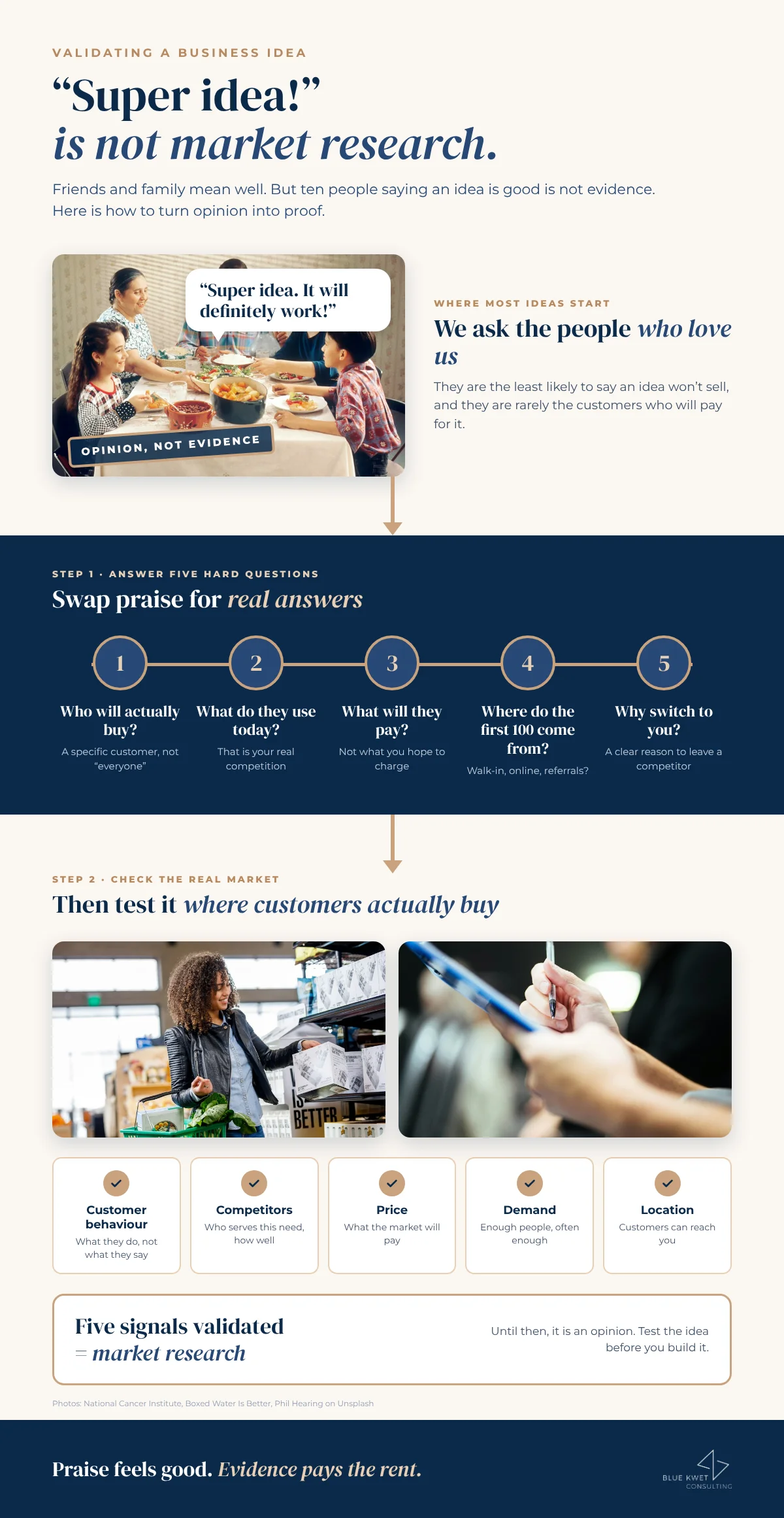
- When we have a new product idea, we usually ask friends and family first. They say, “Super idea, it will definitely work.”
- That is encouragement, not market research. Ten people saying it’s a good idea is not evidence.
- Real validation answers who will buy, what they use today, what they will pay, where your first customers come from, and why they would switch to you.
- When customer behaviour, competitors, price, demand and location all check out, that is market research.
Most new product ideas get tested the same way. We share it with friends and family over dinner or on a WhatsApp group, and they tell us what we hope to hear: “Super idea. It will definitely work.”
It feels like validation. It isn’t. The people who care about us are the least likely to tell us an idea won’t sell. They don’t want to hurt our feelings, and they often don’t know the market well enough to judge. Most importantly, they are rarely the customers who will actually pay for the product.
Why praise feels like proof
When several people we trust say the same thing, it is natural to believe it. But think about what they were actually asked. They heard a short description of an idea, with no price, no competitor next to it and no need to spend their own money. Saying “yes, I’d buy that” costs nothing. Handing over cash every month is a very different decision.
That is the gap that sinks many new ventures. The founder hears enthusiasm, invests in stock, a shop or an app, and only then discovers that real customers behave differently.
The questions that actually matter
Real market research starts with harder questions:
1. Who is actually going to buy this?
Not “everyone”. A specific customer, with a specific need, who you can find and talk to. If you can’t describe that person clearly, you don’t yet have a market.
2. What are they using instead today?
Every customer is already solving the problem somehow, even if badly. That existing habit, product or shop is your real competition, and it is often stronger than it looks.
3. How much are they ready to pay?
Not what you would like to charge. What customers will actually hand over, compared with what they spend on the alternative today.
4. If you get 100 customers a month, where will they come from?
Walk-in, online, referrals, a sales team? If you can’t say where the first 100 come from, the plan has a gap that no amount of enthusiasm will fill.
5. If competitors already exist, why would people leave them for you?
Better price, better quality, more convenient, something new? There has to be a clear reason to switch, and ideally customers should say it, not you.
Praise is not evidence
Ten people saying an idea is good proves only that ten people were polite. Evidence comes from checking five things against the real market:
- Customer behaviour: what people actually do and buy, not what they say they might do
- Competitors: who is already serving this need, and how well
- Price: what the market will pay
- Demand: whether enough people want it, often enough
- Location: whether your customers can reach you, or you them
When these are validated, you have market research. Until then, you have an opinion.
How to get honest answers
You don’t need a big budget to start. Talk to people who match your target customer but don’t know you. Ask about what they do today rather than whether they like your idea. Visit competitors and watch what customers buy. If you can, run a small test, such as a pre-order, a stall or a short trial, and see whether people pay.
Try the checker below on your own idea:
Is your idea validated, or just liked?
Be honest. For each question, pick how sure you are.
Test the idea before you build it
A few weeks spent answering these questions costs far less than launching a product nobody buys. Keep the encouragement from friends and family, but build your plan on evidence. If you want an outside view, a feasibility study puts your idea through exactly these checks before you invest.
Related: A Google Search Is Not a Market Study · Busy Road, Low Rent? How to Choose a Business Location
What our clients say

“We wanted to take Surplus Market into the UAE and needed someone to question our plans before we spent money. That is what BLUE KWET did. The entry plan was practical and told us clearly what to do first.”


“I know Ayurveda, but presenting it to investors is a different skill. BLUE KWET prepared our project report and investor presentation with us, and gave us a growth plan that respects what Niramaya stands for.”


“We brought BLUE KWET in on a market feasibility study in Saudi Arabia for one of our government clients. They were careful with the research, clear in how they presented it, and easy to work with throughout.”


“We worked with BLUE KWET on a feasibility study for one of our clients, an education brand. They were thorough with the market and the numbers, and quick to respond whenever we needed changes.”

Want to talk about your business? BLUE KWET advises business owners across the GCC and India on strategy, structure and growth.
Book a consultationWhatsApp usMore insights

Busy Road, Low Rent? How to Choose a Business Location
Sabir K M31 Oct 2026 · 3 min read

A Google Search Is Not a Market Study
Sabir K M31 Oct 2026 · 4 min read

Why Do Businesses Fail? 5 Common Causes and How to Avoid Them
 Bareer Jazim
17 Apr 2020 · 5 min read