Busy Road, Low Rent? How to Choose a Business Location


In short
- A crowded main road with low rent is not automatically a good location.
- The first question is whether the people passing by are your customers.
- Check nearby businesses: how many tables they fill, at what times, and their average bill.
- Then do the simple maths: can this spot realistically bring the sales you need to cover your costs?
“It’s on the main road, there’s always a crowd, and the rent is low.” We hear this often from people about to open a shop or café. It sounds like a perfect location.
But a crowd and low rent alone do not make a location good. Before you sign, you need to prove it.
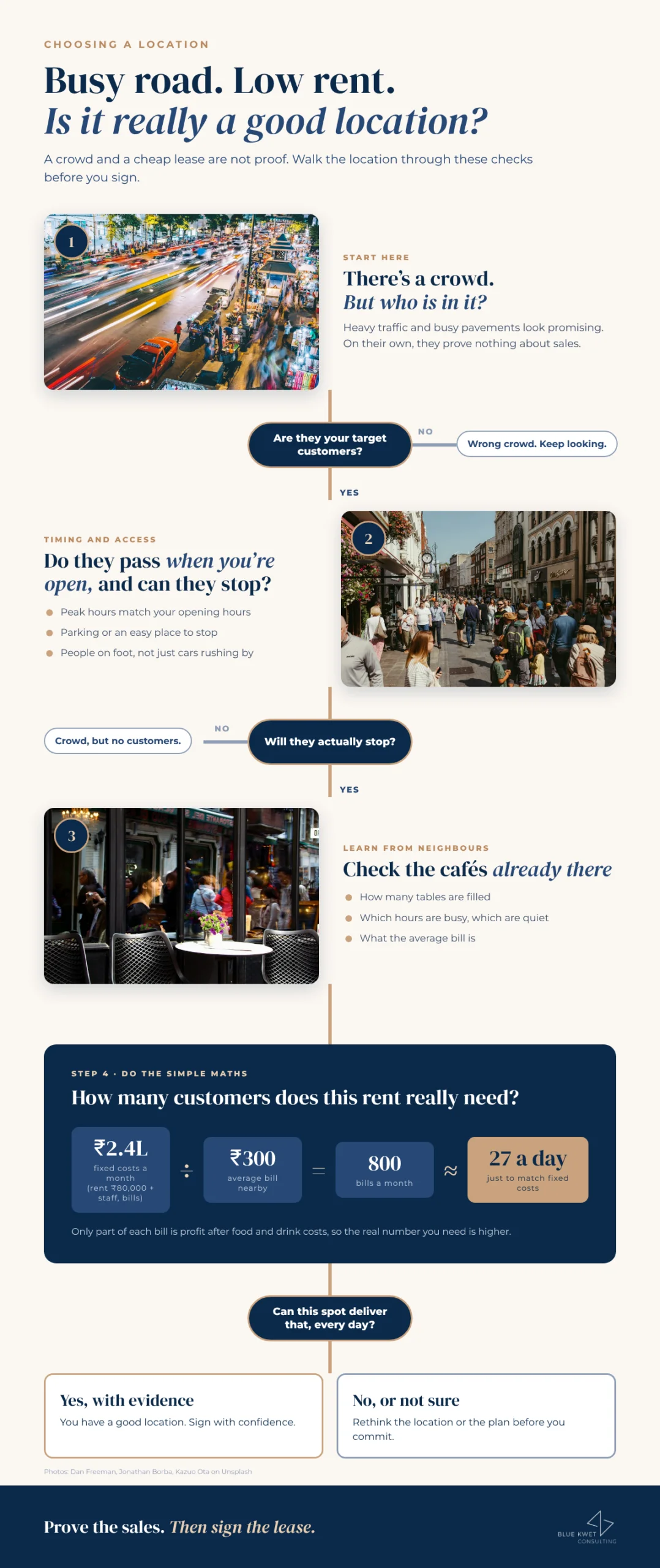
Crowd is not the same as customers
The first thing to check is whether the people you see are your target customers.
Say you are opening a café. A road can be packed with traffic, but if most of it is commuters driving straight past, or people who would never stop for coffee, that crowd does nothing for you. If people don’t stop, it doesn’t matter how many go by.
So instead of counting heads, look for your customers:
- How many of the people passing match your target customer?
- Do they pass at the hours you plan to be open, for example in the evening and at night?
- Is there anywhere to stop or park?
Learn from the businesses already there
Nearby cafés and shops are your best evidence. Visit them at different times and note:
- how many tables are filled
- at what times they are busy, and when they are quiet
- what the average bill looks like
That tells you what demand in the area really is, not what the crowd suggests.
Do the simple maths
Now put numbers on it. Take an example:
- Rent: ₹80,000 a month
- Total fixed costs (rent, salaries, utilities and so on): ₹2.4 lakh a month
- Average bill in nearby cafés: ₹300
To bring in even ₹2.4 lakh of sales, you need 800 bills a month, which is about 27 customers every day. And since only part of each bill is profit after the cost of food and drinks, the number you actually need is higher.
So the real question is simple: can this location realistically bring you that many customers, every day, at that bill size?
Try it with your own figures:
How many customers does this location need?
Change any figure. The results update as you type.
Prove it before you commit
A good location is one where you can show, with evidence, that the sales you need are realistic. Not one where the road looks busy and the rent looks cheap.
Testing locations against real numbers is part of every feasibility study we carry out before a client invests.
Related: A Google Search Is Not a Market Study · "Super Idea!" Is Not Market Research: How to Validate a Business Idea
What our clients say

“We wanted to take Surplus Market into the UAE and needed someone to question our plans before we spent money. That is what BLUE KWET did. The entry plan was practical and told us clearly what to do first.”


“I know Ayurveda, but presenting it to investors is a different skill. BLUE KWET prepared our project report and investor presentation with us, and gave us a growth plan that respects what Niramaya stands for.”


“We brought BLUE KWET in on a market feasibility study in Saudi Arabia for one of our government clients. They were careful with the research, clear in how they presented it, and easy to work with throughout.”


“We worked with BLUE KWET on a feasibility study for one of our clients, an education brand. They were thorough with the market and the numbers, and quick to respond whenever we needed changes.”

Want to talk about your business? BLUE KWET advises business owners across the GCC and India on strategy, structure and growth.
Book a consultationWhatsApp usMore insights

“Super Idea!” Is Not Market Research: How to Validate a Business Idea
Sabir K M31 Oct 2026 · 4 min read

A Google Search Is Not a Market Study
Sabir K M31 Oct 2026 · 4 min read

Why Do Businesses Fail? 5 Common Causes and How to Avoid Them
 Bareer Jazim
17 Apr 2020 · 5 min read