A Google Search Is Not a Market Study


In short
- Google is a good place to start, but a search does not complete your market study.
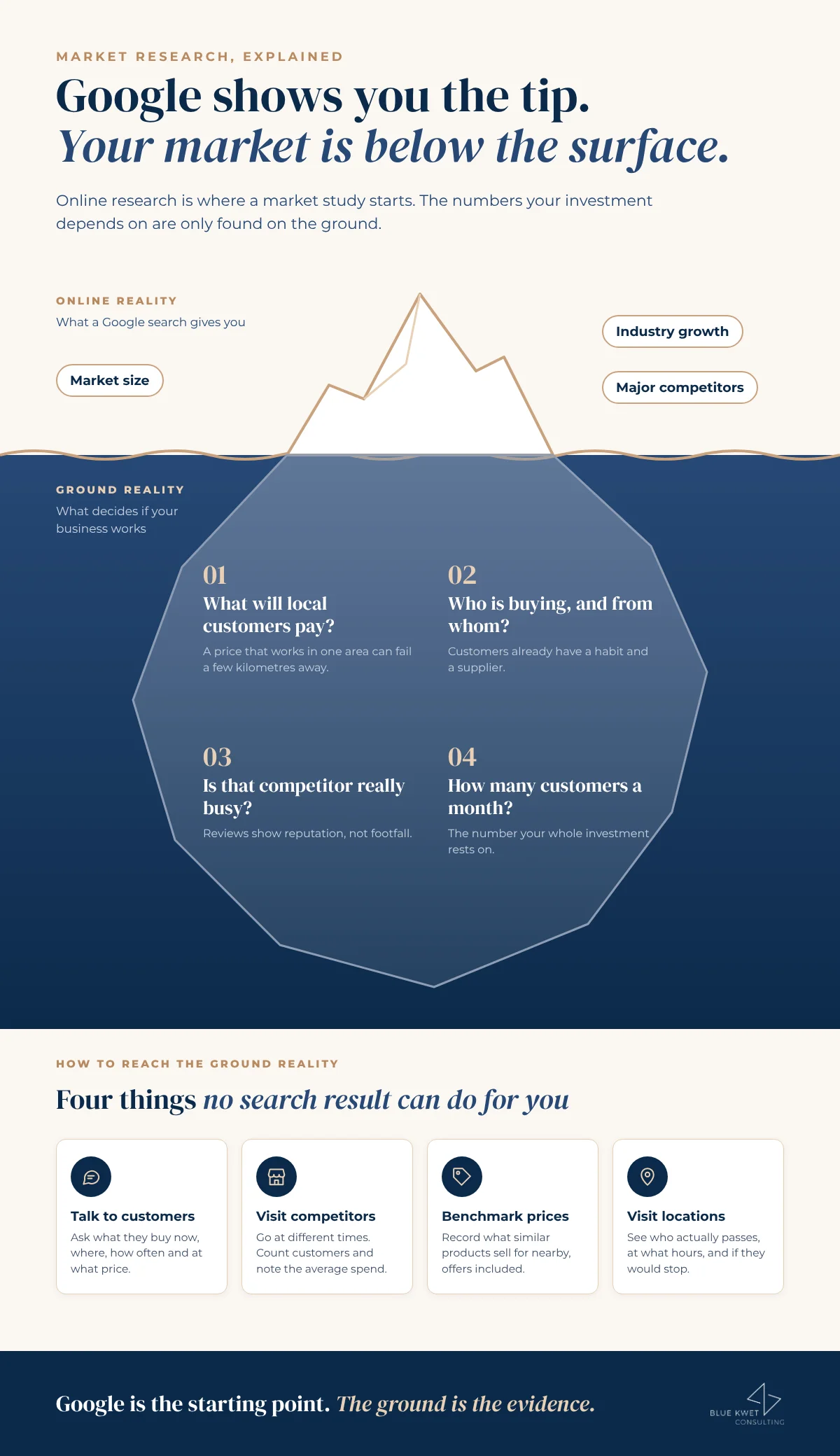
- Online research gives you market size, industry growth and the big competitors. It cannot tell you what your local customers will pay or how many will actually come.
- That evidence comes from the ground: talking to customers, visiting competitors, benchmarking prices and checking locations.
- Before you invest, understand the ground reality, not just the online reality.
Many new ventures start the same way. The founder searches online, finds reports saying the market is large and growing, sees a few successful competitors, and decides there is room for one more business.
That is a big mistake. Not because Google is wrong, but because it answers a different question from the one your investment depends on. Google tells you about the market. Your business depends on your customers, in your area, at your price.
What Google can tell you
Online research is genuinely useful, and you should do it. In a short time you can learn:
- the overall market size
- how fast the industry is growing
- who the major competitors are, and roughly how they position themselves
- general trends, such as what customers say they like and dislike in reviews
That is a good starting point. It tells you the category is worth a closer look. But notice that almost all of it is national or global, and almost all of it describes other businesses, not yours.
What Google cannot tell you
The questions that decide whether your business will work are local and specific:
- How much will customers in your area pay? A price that works in one city, or even one neighbourhood, can fail a few kilometres away.
- Who is buying today, and from whom? Customers already have a habit and a supplier. You need to know what that habit is before you try to change it.
- Is that competitor actually busy? A shop with hundreds of five-star reviews and a strong Instagram page may still have empty tables on a weekday afternoon. Reviews show reputation, not footfall.
- Realistically, how many customers will you get in a month? This is the number your whole investment rests on, and no search result can give it to you.
A market that is growing nationally can still be crowded on your street. A category that looks small online can be under-served in your area. Only the ground tells you which.
Where the real evidence comes from
To answer those questions you have to go out and look. A proper physical market study usually includes four things:
- Direct conversations with customers. Ask people in your target group what they buy now, where, how often and what they pay. Ten honest conversations with real buyers teach you more than a hundred online articles.
- Competitor visits. Go at different times of day and on different days of the week. Count customers, watch what they order, note the average spend and how busy the staff are. Visit as a customer, not as a researcher.
- Pricing benchmarks. Record what similar products and services sell for nearby, including offers and packages. Your price should come from this evidence, not from what you hope to earn.
- Location visits. Stand at the locations you are considering. See who actually passes, at what hours, and whether they are the kind of people who would stop and buy.
None of this needs expensive tools. It needs time, a notebook and the discipline to record what you see rather than what you expect.
A simple way to think about it
Treat Google research as the starting point of your study, and the physical market study as the real market evidence. The first tells you where to look. The second tells you what is actually there.
If your online research and your field work agree, you can invest with more confidence. If they disagree, trust what you saw on the ground, and find out why before you spend.
Check the ground before you invest
Before you sign a lease, hire a team or commit capital, make sure you understand the ground reality, not only the online reality. A few days of field work costs far less than a business built on a search result.
If you would like help testing an idea properly, a feasibility study brings this evidence together, from customer conversations to competitor and location checks, before you commit.
Related: Busy Road, Low Rent? How to Choose a Business Location · "Super Idea!" Is Not Market Research: How to Validate a Business Idea
What our clients say

“We wanted to take Surplus Market into the UAE and needed someone to question our plans before we spent money. That is what BLUE KWET did. The entry plan was practical and told us clearly what to do first.”


“I know Ayurveda, but presenting it to investors is a different skill. BLUE KWET prepared our project report and investor presentation with us, and gave us a growth plan that respects what Niramaya stands for.”


“We brought BLUE KWET in on a market feasibility study in Saudi Arabia for one of our government clients. They were careful with the research, clear in how they presented it, and easy to work with throughout.”


“We worked with BLUE KWET on a feasibility study for one of our clients, an education brand. They were thorough with the market and the numbers, and quick to respond whenever we needed changes.”

Want to talk about your business? BLUE KWET advises business owners across the GCC and India on strategy, structure and growth.
Book a consultationWhatsApp usMore insights

“Super Idea!” Is Not Market Research: How to Validate a Business Idea
Sabir K M31 Oct 2026 · 4 min read

Busy Road, Low Rent? How to Choose a Business Location
Sabir K M31 Oct 2026 · 3 min read

Why Do Businesses Fail? 5 Common Causes and How to Avoid Them
 Bareer Jazim
17 Apr 2020 · 5 min read