How to Franchise Your Business in the UAE, Step by Step


In short
- Franchise only after at least one outlet has been profitable for a while and runs without you being there every day.
- Protect your brand name and logo before you talk to any partner.
- Pick the franchise model, or mix of models, for each market: FOFO, FOCO, master, area development, conversion and more.
- Set fees and royalty from the partner’s numbers, not only yours.
- Write down everything: SOPs, the operations manual, training and supply. Then put it on digital systems every outlet uses, not paper and spreadsheets.
- Get the agreement prepared with a lawyer, then select partners carefully using a partner evaluation form, not just an application.
- Your first two or three franchise outlets decide whether the brand grows or gets damaged.
Almost every successful restaurant, salon, clinic or retail brand in the UAE reaches the same moment. A regular customer, a relative or an investor asks: “Can I open one of these?”
That question is a compliment, and also where many brands make expensive mistakes: they sign the first interested person and only later find the business ran well because the founder was there every day.
Franchising works when the system behind your brand can be copied by someone else, in another location, without you. Here is how we take UAE brands through it, step by step.
Step 1: Check if your business is really ready
Before anything else, be honest about four things:
- Profit, not just sales. At least one outlet should have been profitable for a reasonable period, and the numbers should be clear and documented.
- Systems, not people. If your best manager left tomorrow, would the outlet still run the same way?
- A brand people recognise. Customers in your city or community should know the name and ask for it.
- Demand from outside. People should already be asking to open a branch, and from more than one place.
If two of these are weak, fix them first. Franchising a business that is not ready multiplies its problems instead of its profit.
Step 2: Protect your brand
Your brand name and logo are what a franchisee is paying for. Make sure they are registered in your company’s name in the UAE, and in other GCC markets or India if you plan to expand there. Your lawyer will advise you on the right classes and the process, and firms such as Legacy Partners can help you register and protect your trademark across these markets.
Step 3: Choose the right franchise model
Most people have heard of FOFO and FOCO, but there are many more ways to structure a franchise. Here is a quick look at the main ones.
Who owns and who runs the outlet
- COCO (company owned, company operated): your own outlets. They are not franchises, but most networks keep a few as flagships and training stores.
- COFO (company owned, franchise operated): you invest in the outlet and a partner runs it for you.
- FOCO (franchise owned, company operated): the partner invests, and your team runs the outlet for an agreed return.
- FOFO (franchise owned, franchise operated): the partner invests and runs the outlet.
How much territory a partner gets
- Single unit: one outlet in one location.
- Area development: one partner commits to open a set number of outlets in an area over an agreed period.
- Master franchise: one partner gets the rights for a whole country or region, opens outlets there and can sub-franchise them.
How a partner joins the network
- Conversion franchise: an existing independent business in the same line changes over to your brand and system.
- Acquisition franchise: a partner takes over an existing outlet, for example one of your company outlets or one from a franchisee who is leaving.
Hybrid and transition models
In practice, many brands mix these. A common transition model starts as FOCO, so your team runs the outlet while the partner learns the business, and later moves to FOFO once the partner is ready to run it alone. Other brands run COCO flagships in their home city, FOFO outlets elsewhere in the UAE, a master franchise in Saudi Arabia and area development in India.
There is no single right answer. The right mix depends on your brand, your team’s capacity and each market you want to enter. The model also shapes the exclusive territory you give each partner, which we explained in how to decide a franchise’s exclusive territory.
Step 4: Set fees from the partner’s side
Most brands start by asking, “How much can we charge?” A better question is, “Will the partner make enough money to stay with us?”
Build a simple model of one franchise outlet: fit-out, licence, equipment, deposits, staff, rent, working capital and monthly sales. Then decide the franchise fee, the royalty and any marketing contribution so that the partner gets a reasonable payback period. If partners struggle, they cut corners, and that damages your brand.
For partners, the money they put in is an investment in a proven system, not just a cost. We wrote about that in why franchise set-up cost is an investment, not an expense.
Step 5: Write everything down
This is the step most brands underestimate. A franchise partner needs to run your business your way, on a day when you are not there. That means:
- An operations manual: opening and closing, service standards, cash handling, hygiene, customer complaints.
- SOPs for each role: what each person does, step by step, with checklists.
- Product and supply standards: approved suppliers, recipes or specifications, and what the partner must buy from you.
- Brand standards: store design, signage and marketing rules.
- A training plan: how the partner and their team are trained before opening, and how they are checked after.
If you cannot write it down, you cannot franchise it. We explain why the system has to come first in how to franchise your business: build the system first.
Plan the digital side too
A network of franchise outlets cannot run on paper files, printed checklists and shared Google Sheets. As you add partners, you need digital systems that every outlet uses in the same way: point of sale and inventory, daily checklists and audits, training, customer data, and dashboards that show you each outlet’s sales and KPIs in one place. Plan these systems as part of the franchise from the start, not after the tenth outlet.
Step 6: Prepare the franchise agreement
The agreement turns your model into clear rights and duties: territory, term and renewal, fees and royalty, supply, training, audits, use of the brand, and what happens if either side wants to exit.
Have it prepared by a lawyer who works on franchise agreements in the UAE, using your model and manual as the brief. Do not copy another brand’s agreement.
A legal advisory firm such as Legacy Partners in Dubai can help you draft a stronger franchise agreement that covers all of these areas.
Step 7: Select partners carefully
Your first franchise partners matter more than any later ones. If the first two or three outlets do well, the next partners will come to you. If they struggle, the whole market will hear about it.
Prepare a short franchise brochure and an application form. But an application form only tells you what the applicant wants to share. You also need a partner evaluation form, which your team fills in to assess each serious applicant. It should cover:
- Background and history: who the partner is, their track record and their reputation in the market.
- Business capacity: the investment they can commit, their access to funds, and the team and time they can give the outlet.
- Other businesses: what else they own or run, and whether any of it competes with your brand or will pull their attention away.
- Market knowledge: how well they know the location and your customers.
- Fit with your brand: whether they share your standards and are willing to follow your system.
Score every applicant on the same form, so you compare partners fairly and not just on first impressions. It is often better to say no to an investor with a large budget and the wrong attitude.
Where to start
Building a complete franchise system usually takes a few months, so start with an honest readiness check. Our franchise consultants in Dubai build the full franchise system with UAE brands, from the readiness review and fee model to manuals and partner recruitment, for the UAE, the wider GCC and India. We also help franchise brands plan their digital strategy and digital transformation, so every outlet runs on the same systems and you can see the whole network’s numbers in one place.
If you would like a second opinion on whether your brand is ready, send us a note with a short story of your brand and your outlet numbers.
Planning to franchise your business? BLUE KWET has helped business owners across the GCC and India plan, structure and launch franchise models.
Talk to us about your Franchise Growth PlanWhatsApp usMore insights

How to Decide a Franchise’s Exclusive Territory
Bareer Jazim21 Oct 2026 · 2 min read

Franchising Your Business? Why the Setup Cost Is an Investment, Not an Expense
Bareer Jazim21 Oct 2026 · 3 min read
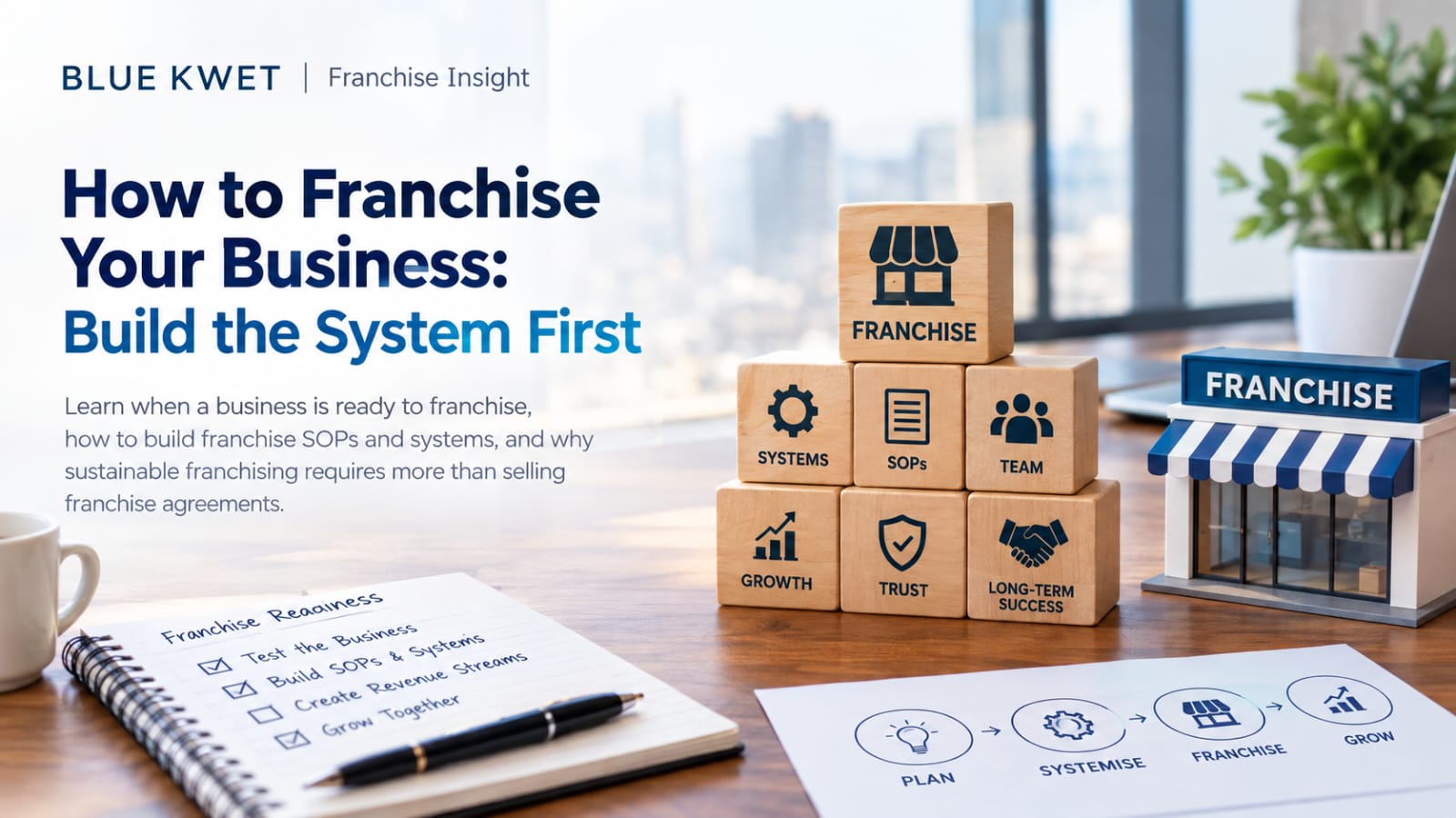
How to Franchise Your Business: Build the System First, Sell Franchises Second
Bareer Jazim12 Sep 2026 · 6 min read