
FRANCHISE INSIGHT
Franchising Is a Business – But Selling Franchises Is Not the Business
A practical perspective on franchise readiness, revenue streams, systems and the ongoing responsibility of a franchisor.
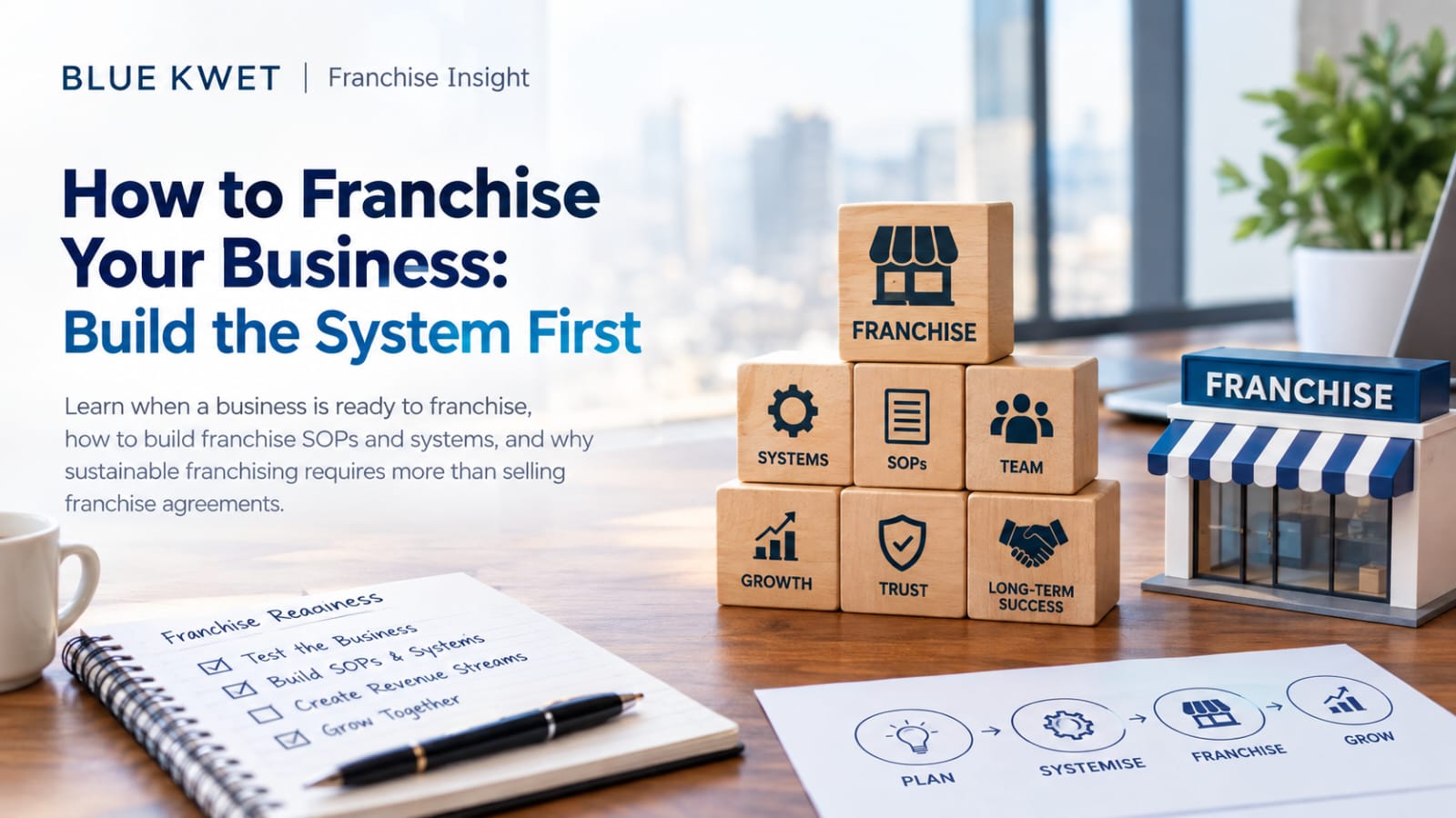
Franchise Readiness: Quick Takeaways
| Not every successful business is immediately ready to franchise. Franchise readiness depends on the industry, nature and complexity of the business. |
| Test before you franchise. As a general approach, operate at least one or two outlets and test the model for around 6-12 months, depending on the business and market opportunity. |
| Build the system first. Develop SOPs and processes, test them in actual operations, correct the gaps and continuously update the system. |
| Franchising has multiple revenue opportunities. Franchise fees, renewals, royalties, product margins, marketing contributions and training can all form part of the franchisor revenue model. |
| Selling the franchise does not end the franchisor’s responsibility. Sustainable franchising requires the franchisor and franchisee to grow together, supported by a system that builds confidence and trust. |
If you are considering how to franchise your business, the first question should not be how much franchise fee you can charge or how quickly you can find franchisees.
The first question should be: Is the business actually ready to be franchised?
Franchising can create multiple revenue opportunities and accelerate expansion. But before another entrepreneur invests in your concept, the business needs to be tested, refined and converted into a system that can be replicated.
When Is a Business Ready to Franchise?
There is no universal formula that says a business must be three years old, operate five outlets or achieve a particular turnover before it can be franchised.
Franchise readiness differs from industry to industry.
The nature of the product or service matters. The complexity of the operation matters. Sometimes, the market opportunity itself matters.
As a general approach, I prefer to see a business operating at least one or two outlets before moving seriously towards franchising. Whether it is a product-based or service-based business, the model should ideally have been operated and observed for a reasonable period – perhaps six months or twelve months.
This is not a fixed rule. For a relatively simple business, the required period may be shorter. A complex operation may require considerably more time.
There can also be situations where a market opportunity needs to be captured quickly. In such cases, the approach and timeline may need to change.
Do not franchise a business before making it systematic.
Use the Testing Period to Build the Franchise System
The period before franchising is not simply about waiting for six or twelve months to pass. It should be used to understand how the business actually operates.
This is when the business should start developing its SOPs, processes and systems. More importantly, those systems should be implemented and tested in the actual operation.
- When something does not work, correct it.
- When a process can be improved, improve it.
- When experience shows that an SOP needs to change, update it.
The objective is to eventually give another entrepreneur a business model that can be followed systematically.
Opening a successful outlet yourself and enabling somebody else to reproduce that outlet are two different things.
That transition – from an owner-operated business into a system another entrepreneur can operate – is one of the most important steps in making a business franchise-ready.
How Does a Franchisor Make Money?
Once the system is ready, franchising can become an attractive business model for the franchisor. There is not only one way for a franchisor to generate revenue.
- Initial franchise fee: when a new franchise is awarded.
- Renewal or successor fee: when the franchise agreement is renewed.
- Royalty or product margin: depending on how the franchise business model is structured.
- Central marketing contributions: where marketing and promotions are managed centrally.
- Training fees: including additional training beyond the initial training structure.
- Default-related penalties or charges: where clearly defined franchise obligations are not followed and the agreement provides for such charges.
So yes, there are multiple opportunities to generate revenue from a franchise network. That is precisely why I say franchising itself is a business.
“Give Franchises and Make Money” Is Not a Franchise Strategy
After I spoke about the revenue opportunities in franchising, I received an interesting response. Some people effectively said: “Then why not just give more franchises and make money?”
My answer is simple. If by that you mean collecting money from people and considering your job finished once the franchise is sold, that may be a way of making quick money. But it is not the way to build a sustainable franchising business.
A franchisor’s responsibility does not end when the franchise fee reaches the bank account. In many ways, that is where the responsibility begins.
Someone else is now putting their capital into your business concept. They are investing based on the brand, model and system you have created. That creates an obligation beyond merely allowing them to use your name.
The Franchisor and Franchisee Have to Grow Together
A sustainable franchise relationship cannot be built around the idea that one party simply makes money from the other.
The franchisor and franchisee have to stand together.
The franchisee needs the systems, guidance and continuing support of the franchisor. The franchisor needs franchisees who can successfully implement the business model and represent the brand.
The support a franchisor provides is also what gradually creates trust and confidence among franchisees.
If franchisees feel that the franchisor is interested only in collecting the initial fee, royalty and other charges, that relationship will eventually become difficult.
When franchisees can see that the franchisor is actively helping them operate the system and improve the business, the relationship becomes considerably stronger. And that is ultimately what allows a franchise network to grow.
Build the System First. Monetize the System Second.
Franchising can absolutely be a profitable business. There can be franchise fees, renewal fees, royalties, product margins, marketing contributions, training revenues and other legitimate revenue streams.
But those revenues should come from a properly developed franchise ecosystem.
- Operate the business.
- Test it.
- Understand its complexities.
- Develop the SOPs.
- Put the systems into practice.
- Correct what does not work.
- Update what needs improvement.
- Make the business systematic enough for another entrepreneur to operate.
Only after that should the focus move aggressively towards franchise expansion.
The objective should never be simply to sell as many franchises as possible. The objective should be to build a system in which the franchisor can make money because the franchise network itself is working.
That is the difference between selling franchises and building a franchising business.
Frequently Asked Questions About Franchising a Business
How do I know if my business is ready to franchise?
There is no single formula for franchise readiness. It depends on the industry, nature of the product or service, complexity of operations and market conditions. Before franchising, the business should have a tested operating model and systems that can be replicated by another entrepreneur.
How long should I operate my business before franchising?
As a general approach, I prefer a business model to be operated and tested for around 6-12 months, ideally through at least one or two operating outlets. However, this can be shorter or longer depending on the complexity of the business, industry and market opportunity.
Do I need multiple outlets before franchising?
There is no universal requirement applicable to every business. However, operating one or two outlets provides an opportunity to test whether the model, processes and SOPs work consistently before transferring them to franchisees.
How does a franchisor make money?
Depending on the franchise model, franchisor revenue can include initial franchise fees, renewal fees, royalties, margins on products supplied to franchisees, centralized marketing contributions, training fees and other charges defined within the franchise structure.
What should be prepared before offering a franchise?
The business should first understand and document how its operations work. SOPs, processes and systems should be developed, implemented, tested, corrected and updated. The objective is to create a business system that another entrepreneur can follow consistently.
Thinking About Franchising Your Business?
Before offering your first franchise, assess whether your business model, operating systems, SOPs and franchise structure are genuinely ready for replication.
BLUE KWET works with business owners on franchise readiness, franchise model development, operational systems and structured franchise expansion.
About the Author
Bareer is a management and franchise consultant working with businesses on franchise strategy, business models, operational systems, SOP development and structured expansion. His work focuses on helping businesses move from founder-dependent operations towards more systematic and scalable business models.
