

What Do Business Consultants Actually Help With?


In short
- “Consulting” covers different kinds of help, because businesses get stuck in different places.
- No clear direction? Strategy and operations support helps you choose where to go and improves how work gets done.
- Sales but no money left? Look beyond the sales total at costs, cash flow, budgets and what is left after expenses.
- A team, but no one owns the task? Define roles, performance expectations and clear people processes.
- The same data entered three times? Choose and connect systems that support the way your team works.
Many business owners have a vague picture of what a consultant does. Some imagine a thick report that sits on a shelf. Others think consultants only help large corporations. In reality, most of our work starts with a simple, very practical question from an owner who feels stuck.
Different business problems need different kinds of support. Here are four questions we hear again and again from businesses across the GCC and India, and what consulting looks like for each one.
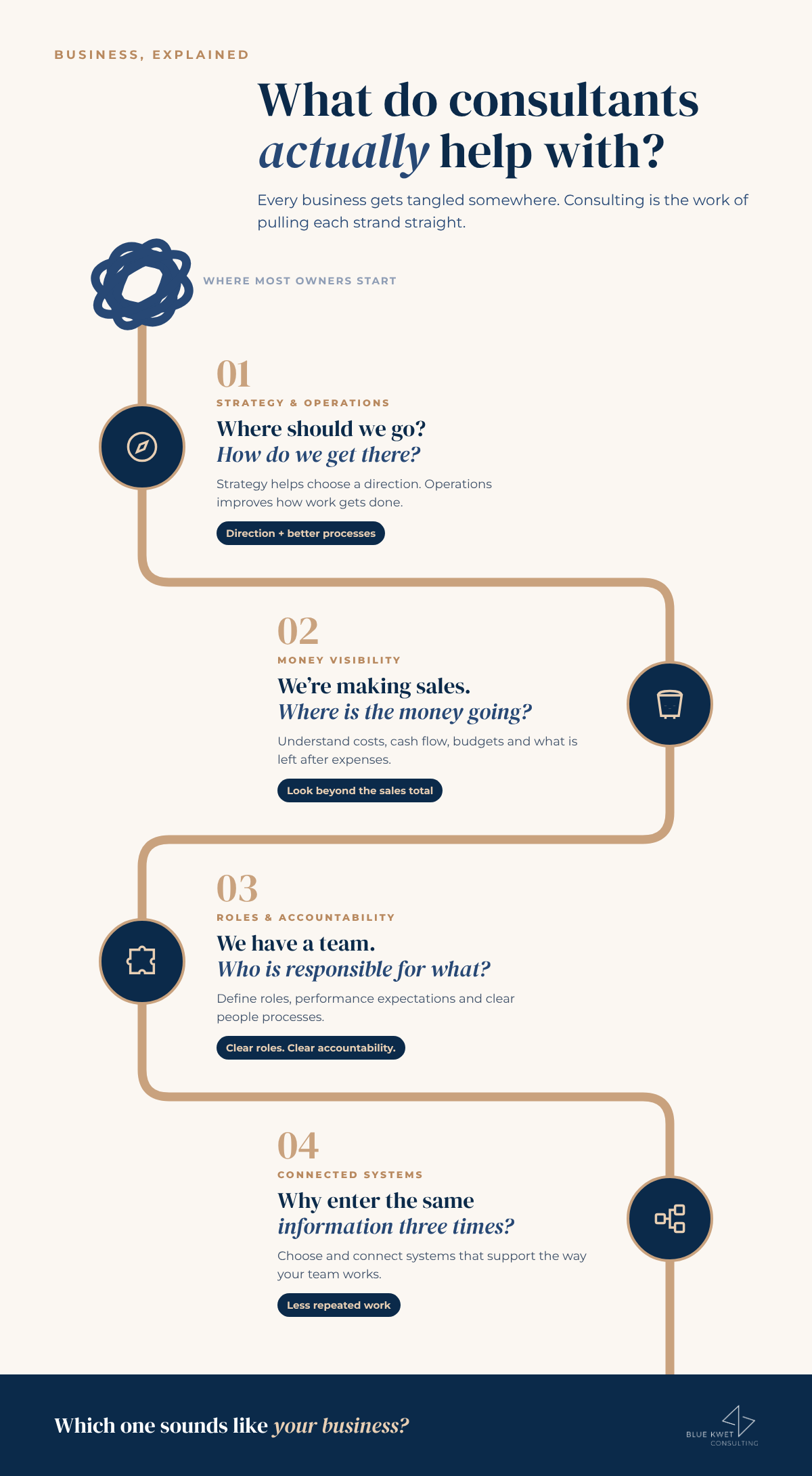
1. “Where should we go? How do we get there?”
This is the classic strategy question. The business is running, but growth has slowed, the market has changed, or the owner has several ideas and no clear way to choose between them.
Strategy helps you choose a direction: which markets, customers, products or formats to focus on, and which to say no to. Operations then improves how the work actually gets done, so the team can deliver on that direction day after day.
You need both. A good direction with messy processes stalls. Efficient processes pointed in the wrong direction only get you to the wrong place faster. The goal is simple: direction plus better processes.
2. “We’re making sales. Where is the money going?”
This one surprises a lot of owners. Sales look healthy, the shop or office is busy, and yet there is never enough cash at the end of the month.
It is like a bucket with holes in it. Pouring in more sales does not help if the money keeps leaking out. The answer is to look beyond the sales total and understand:
- Costs: what each product, service or branch really costs to run.
- Cash flow: when money comes in and when it goes out, including credit given to customers.
- Budgets: what you plan to spend, and whether you stick to it.
- What is left after expenses: the profit you actually keep.
When these numbers are clear and reviewed regularly, owners stop guessing and start fixing the real leaks. Good management reporting and data analytics make this visible in one place.
3. “We have a team. Who is responsible for what?”
As businesses grow, roles often grow by accident. People take on tasks because someone has to, and soon no one is sure who owns what. Work falls through the cracks, or two people do the same job while a third task is forgotten.
The fix is to define roles, performance expectations and clear people processes:
- Clear roles, so every important task has one owner.
- Performance expectations, so each person knows what good looks like and how it will be measured.
- People processes for hiring, onboarding, reviews and growth, so the business does not depend on one person’s memory.
The result fits on one line: clear roles, clear accountability. When everyone knows their piece of the puzzle, the whole picture comes together.
4. “Why enter the same information three times?”
Many teams type the same order, customer or invoice into a spreadsheet, then into the billing software, then into a report for the owner. It wastes time, creates errors and makes the numbers hard to trust.
Technology support helps you choose and connect systems that support the way your team works. That does not always mean expensive new software. Often it means picking the right tools, connecting what you already have, and removing the steps that do not add value.
The aim: less repeated work and more connected systems, so your team spends its time serving customers instead of copying data.
Which question sounds like your business?
Most businesses recognise themselves in at least one of these questions. Many recognise all four, because they are connected. Unclear direction leads to unclear roles. Unclear roles lead to messy systems. Messy systems hide where the money is going.
A good consultant does not just hand over advice. They help you untangle the knot one strand at a time: understand the real problem, agree on a plan, and put the structures in place so the improvement lasts after the engagement ends.
If one of these questions keeps you up at night, it is worth a conversation. This is the kind of work we do every day with existing businesses that are ready to grow on a stronger base.
More insights


Not Getting Enough Leads? Check This Before Changing Your Marketing Agency
 Sabir K M
21 Oct 2026 · 2 min read

Want to talk about your business? BLUE KWET advises business owners across the GCC and India on strategy, structure and growth.
Book a consultationWhatsApp us