








Your Competitor Cut Prices. Should You Follow?


It happens all the time. A competitor nearby drops their price, and the natural reaction is to drop yours too. It feels like the safe move. Often, it is the most dangerous one.
A simple example
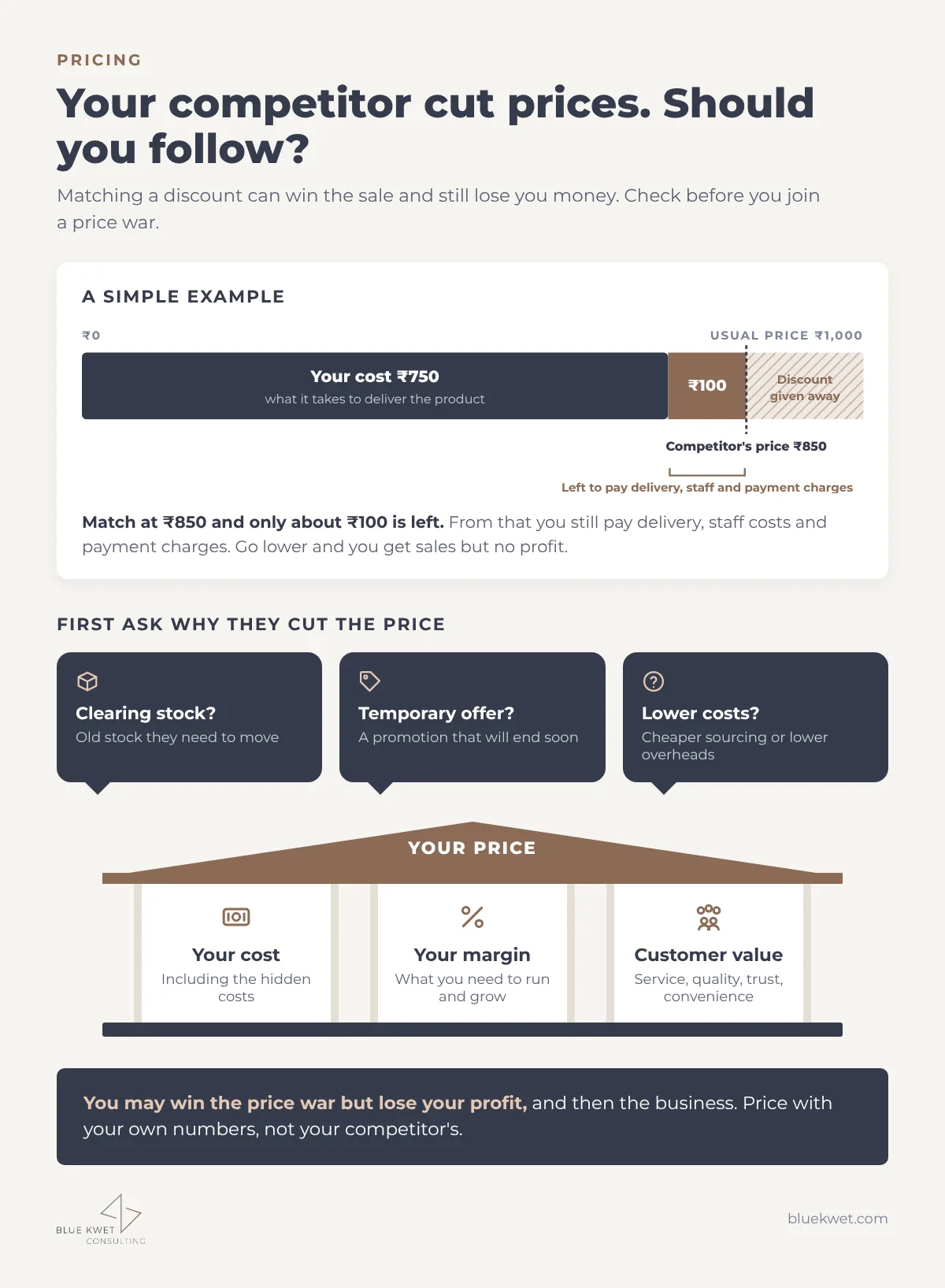
Imagine a product that normally sells for ₹1,000. Your competitor starts selling it for ₹850. Your cost for that product is ₹750.
If you match them at ₹850, you keep about ₹100 per sale. Out of that, you still have to pay for delivery, staff costs and payment charges. Go any lower and you will still make sales, but there will be no profit left.
Ask why the competitor cut the price
Before you react, find out what is really happening:
- Are they clearing old stock?
- Is it a temporary offer that will end in a few weeks?
- Do they simply have a lower cost structure than you, for example cheaper sourcing or lower overheads?
Each answer calls for a different response. None of them automatically means you should copy the price.
Set your price on three things
Do not copy competitor pricing. Decide your price by checking three things:
- Your cost. What does it really cost you to deliver this product, including the hidden costs?
- Your margin. What do you need to earn on each sale to run and grow the business?
- Your customer value. What do your customers value about buying from you: service, quality, trust, convenience?
The takeaway
You may win the price war, but still lose your profit. Keep losing profit, and you lose the business. Price with your own numbers, not your competitor’s. Reviewing cost, margin and pricing is a regular part of how we help existing businesses grow.
What our clients say

“As we grew, roles got mixed up and too many decisions came to the directors. BLUE KWET redrew our structure, set KRAs and KPIs for each role and wrote down our processes. What I liked most is that they did not stop at documents. They trained our team to follow them.”


“We wanted to take Surplus Market into the UAE and needed someone to question our plans before we spent money. That is what BLUE KWET did. The entry plan was practical and told us clearly what to do first.”


“I know Ayurveda, but presenting it to investors is a different skill. BLUE KWET prepared our project report and investor presentation with us, and gave us a growth plan that respects what Niramaya stands for.”


“We brought BLUE KWET in on a market feasibility study in Saudi Arabia for one of our government clients. They were careful with the research, clear in how they presented it, and easy to work with throughout.”


“As a founder I was involved in almost everything. BLUE KWET helped us restructure the team and plan our growth, and guided me on bringing new partners into the firm the right way.”


“We brought BLUE KWET in to restructure an educational institution in India. People there had done things one way for years, so it needed patience, and the team had it. The SOPs they wrote are simple enough that the staff actually use them.”


“We worked with BLUE KWET on a feasibility study for one of our clients, an education brand. They were thorough with the market and the numbers, and quick to respond whenever we needed changes.”


“Your expertise and insights have been instrumental in helping us navigate challenges and make informed decisions. The strategic solutions you have offered have significantly contributed to our growth and improved operational efficiency.”


“I introduced BLUE KWET to a food processing company I was advising, and we ended up working on it together. I looked after the food technology side, and they set up the organisation structure, SOPs, KPIs, performance reviews, meeting routines and dashboards. Our work fitted together well, and the management now has one clear way to run the business.”

Want to talk about your business? BLUE KWET advises business owners across the GCC and India on strategy, structure and growth.
Book a consultationWhatsApp usMore insights

What Do Business Consultants Actually Help With?
 Harif Jusaim
24 Oct 2026 · 4 min read

Not Getting Enough Leads? Check This Before Changing Your Marketing Agency
Sabir K M21 Oct 2026 · 2 min read