








How to Professionalise Your Business: 5 Things to Remember


Professionalising your business is easy to say, but not to implement. It does not mean suddenly stepping away and handing everything to employees. It takes a strong plan, a visionary leader and a step-by-step handover: develop a strategy, stay present, train, trust and delegate, and evaluate as you go.
What professionalising a business really means
Few entrepreneurs would say they don’t want a more professional business. Requests to help with professionalisation are among the most common we receive from owners.
Yet many owners misunderstand what it involves. A common belief is that professionalising means stepping away from all business activity at once and delegating everything to employees.
That approach has serious consequences. Staff are left without support, systems are not yet in place, and the business can lose the very things that made it successful. As an organisation professionalises, there are a few things every owner needs to know.
5 things to remember when you professionalise your business
1. Develop a strategy
Organisational change is difficult. Before anything changes, the owner or promoter must plan exactly what will change and how long each change will take.
Without a clear plan, the order, timing and duration of the changes can drift. When that happens, the process will not achieve the result you wanted.
A good professionalisation strategy should set out:
- Which changes will be made
- The order in which they will happen
- How long each stage is expected to take
2. Don’t step away from the business too early
Staff cannot reach the required level in a day, a week or perhaps even a month. Building capability takes time.
The timeline should be set based on your staff: their capacity, attitude, experience and the culture of the organisation. There is no standard schedule that fits every business.
For example, if the process can realistically be completed within three months, the owner should stay closely involved for those three months before delegating all the work to staff.
3. Keep showing up at the office
A common mistake is to reduce office visits and start managing mainly by phone or email. That’s a bad trend.
Remote management sends the wrong signal before the team is ready. It also removes the owner from the place where problems are spotted and solved.
Instead, the owner should:
- Keep attending the office as before.
- Create a clear action plan.
- Train staff for their roles.
- Build a system that works without constant supervision.
Only once these are in place should the owner reduce their involvement.
4. Train, trust, delegate
“Train, trust, delegate” is a useful motto for any company pursuing growth and change. The order matters.
- Train: provide appropriate training in every area the role requires.
- Trust: give staff the confidence and space to apply what they have learned.
- Delegate: hand over responsibility only when staff are capable of handling it.
Decentralising without first assessing the quality and skill sets of your staff will backfire. Structured business training can shorten the time it takes for a team to be ready.
5. Evaluate
Performance evaluation is a vital task, not an optional extra. Once work has been delegated, owners should assess those activities and confirm that staff are performing adequately.
Regular evaluation shows how well your change strategy is working. If it isn’t delivering, update the plan rather than pushing on regardless.
Common mistakes to avoid
Bringing the five principles together, the mistakes that most often derail professionalisation are:
- Stepping away from the business suddenly
- Changing too much without a planned order and timeline
- Managing by phone and email before systems are ready
- Delegating before staff have been trained and assessed
- Failing to review delegated work and adjust the plan
Key takeaways
- Professionalising a business is easy to say but hard to implement; it needs a strong plan and a visionary leader.
- It does not mean handing everything to employees overnight.
- Plan what will change, in what order and over what timeframe.
- Set the timeline around your staff’s capacity, attitude, experience and culture.
- Stay present in the office until training, action plans and systems are in place.
- Train, trust, then delegate, and evaluate delegated work regularly.
Professionalise with a plan
If your business has grown faster than its systems, our work with Existing Businesses helps owners plan and manage this transition, including role clarity and performance systems. You can see the full range of support on our services page.
FAQ
What does it mean to professionalise a business?
It means moving from an owner-dependent way of working to one built on clear plans, trained staff, defined systems and regular evaluation, so the business can run well with less day-to-day involvement from the owner.
How long does it take to professionalise a business?
There is no fixed timeline. It depends on your staff’s capacity, attitude and experience and on your organisation’s culture. Plan each stage and stay involved until staff are ready.
When should an owner start delegating?
Only after staff have been trained, systems are in place and you have assessed that they can handle the work. Delegating before that point usually backfires.
What our clients say

“As we grew, roles got mixed up and too many decisions came to the directors. BLUE KWET redrew our structure, set KRAs and KPIs for each role and wrote down our processes. What I liked most is that they did not stop at documents. They trained our team to follow them.”


“As a founder I was involved in almost everything. BLUE KWET helped us restructure the team and plan our growth, and guided me on bringing new partners into the firm the right way.”


“We brought BLUE KWET in to restructure an educational institution in India. People there had done things one way for years, so it needed patience, and the team had it. The SOPs they wrote are simple enough that the staff actually use them.”


“We partnered with BLUE KWET on SOP development for one of our retail clients. They took the time to understand how the stores actually run, and the SOPs reflected that.”


“Your expertise and insights have been instrumental in helping us navigate challenges and make informed decisions. The strategic solutions you have offered have significantly contributed to our growth and improved operational efficiency.”


“I introduced BLUE KWET to a food processing company I was advising, and we ended up working on it together. I looked after the food technology side, and they set up the organisation structure, SOPs, KPIs, performance reviews, meeting routines and dashboards. Our work fitted together well, and the management now has one clear way to run the business.”

Want to talk about your business? BLUE KWET advises business owners across the GCC and India on strategy, structure and growth.
Book a consultationWhatsApp usMore insights

Why Your Managers Don’t Take Ownership (and What You Can Change)
 Bareer Jazim
22 Oct 2026 · 3 min read
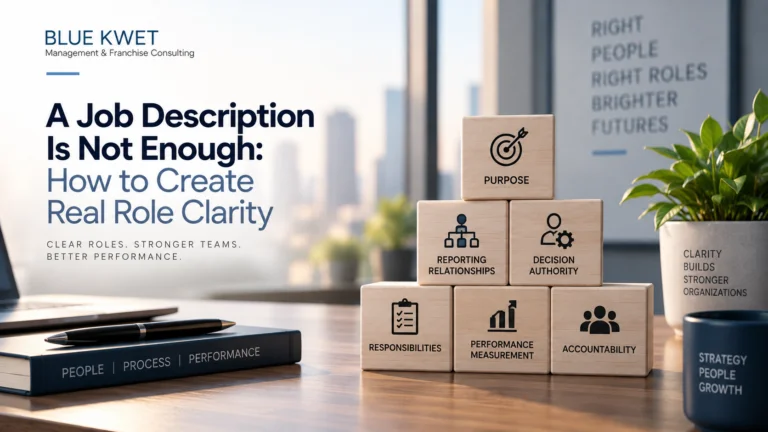
Role Clarity: Why a Job Description Is Not Enough
Bareer Jazim20 Sep 2026 · 5 min read

What a Feasibility Study in Dubai Should Cover Before You Sign a Lease
 Harif Jusaim
2 Nov 2026 · 6 min read