
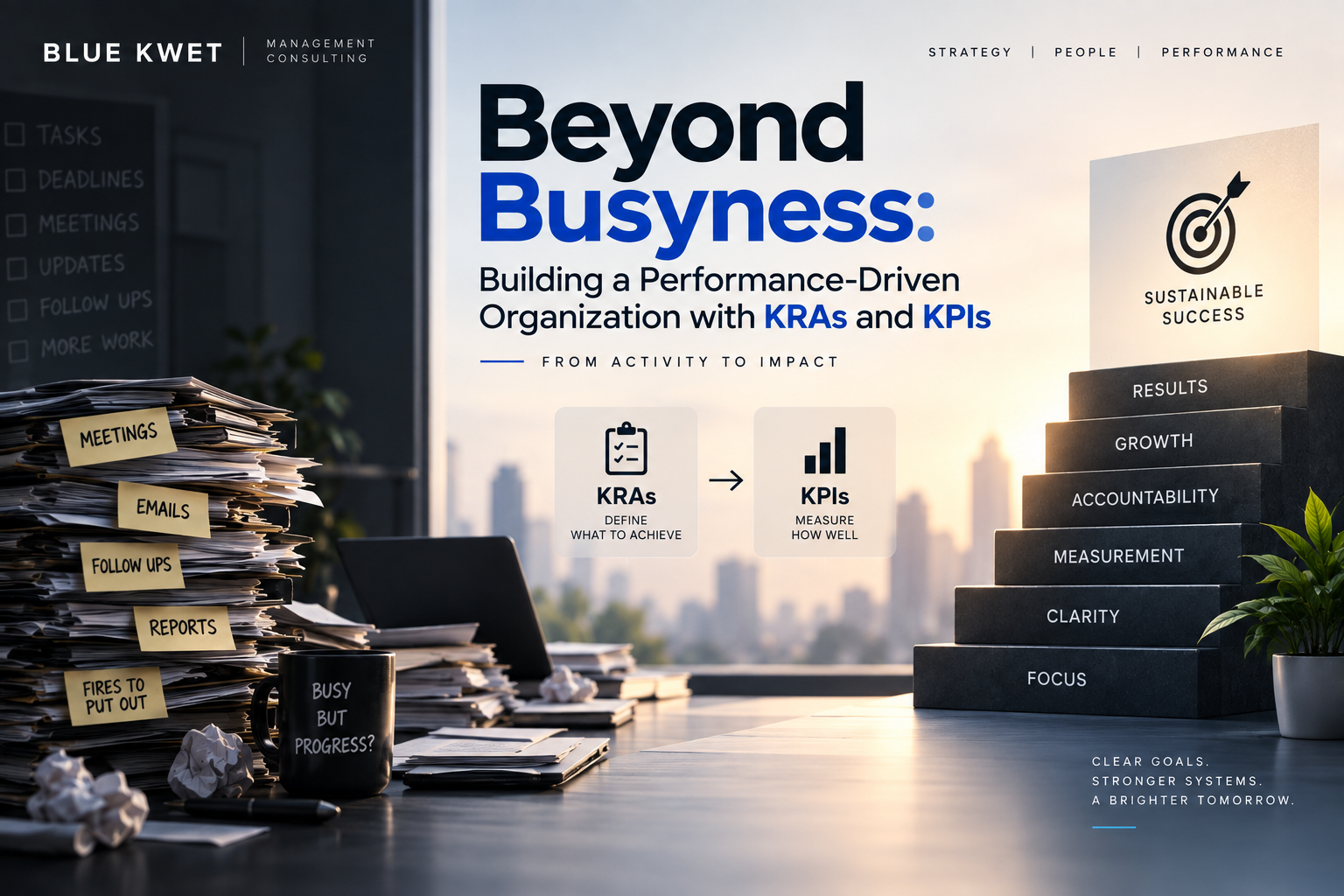
Beyond Busyness: Building a Performance-Driven Organization with KRAs and KPIs
A simple question can reveal a great deal about an organization’s performance management system:
Ask an employee what their sales, revenue, or performance target is for the month.
If they are unable to provide a clear answer, the immediate conclusion should not be that the employee is underperforming. In many cases, the underlying issue is that the organization has not established a sufficiently clear performance framework.
This is a challenge I frequently observe while consulting businesses: employees have defined working hours, salaries, and substantial workloads, yet they do not always have clearly established, measurable targets.
The organization is busy – but busyness and productivity are not the same thing.
Quick Read
- A busy workforce does not necessarily indicate a productive organization.
- Employees need clearly defined responsibilities as well as measurable performance expectations.
- KRAs (Key Result Areas) establish the critical results for which a role is responsible.
- KPIs (Key Performance Indicators) provide measurable indicators for evaluating performance against those responsibilities.
- Clearly structured KRAs and KPIs give employees direction while providing management with greater visibility and control over performance.
The Difference Between Activity and Productivity
In many organizations, employees remain occupied throughout the working day.
A salesperson responds when a sales opportunity arises. A manager attends to files and operational matters as they reach the desk. An accountant processes financial information and completes the required accounting activities.
There is visible activity across the organization.
The challenge arises when activity itself becomes the measure of productivity.
An employee can complete numerous tasks during the day without necessarily knowing the specific result they are expected to achieve during the week, month, or quarter.
Are we measuring how busy our people are, or are we measuring the results they produce?
For an organization seeking sustainable growth, the distinction matters.
KRAs: Defining What Each Role Must Deliver
One of the foundations of an effective performance management framework is the Key Result Area (KRA).
KRAs define the principal areas of responsibility and expected results associated with a role.
The objective is to move beyond simply allocating tasks and establish clarity around what the position is ultimately responsible for delivering.
Naturally, KRAs will differ across functions and levels of responsibility. A salesperson, finance professional, and department manager cannot be assessed against identical expectations.
What matters is that the organization clearly identifies and documents the relevant result areas for each role.
Without that clarity, employees may continue completing their daily activities without having a clearly defined direction for the results those activities should contribute to.
KPIs: Converting Responsibility Into Measurement
Defining responsibility is only the first step.
The next question is:
How will the organization determine whether the expected result has actually been achieved?
This is the role of Key Performance Indicators (KPIs).
KPIs translate the expectations established through KRAs into measurable indicators of performance.
A KRA defines what the employee is responsible for achieving.
A KPI defines how performance against that responsibility will be measured.
This distinction is essential.
Without an appropriate measurement mechanism, performance evaluation can easily become subjective. Managers may rely on impressions such as effort, availability, or visible activity rather than measurable outcomes.
A properly structured KPI framework creates a more objective basis for evaluating employee performance.
Direction for Employees, Control for Management
Well-defined KRAs and KPIs benefit both employees and management.
For employees, they provide direction.
People can understand not only what activities they are expected to perform, but also the results those activities are intended to produce.
For management, they provide visibility and control.
Instead of assessing organizational performance primarily by whether everyone appears occupied, management can review actual performance against predetermined expectations.
This makes performance conversations more objective:
- What was expected?
- What was achieved?
- Where is the gap?
- Where is corrective action required?
Build a Results-Oriented Organization
If an organization wants to improve performance, simply increasing workloads is unlikely to be the solution.
The more important requirement is to establish clarity.
Each relevant role should have clearly defined Key Result Areas, followed by appropriate Key Performance Indicators that allow those results to be measured.
When employees know what outcomes they are responsible for, they gain direction. When management can measure those outcomes consistently, the organization gains greater control over performance.
The objective, therefore, should not be to create an organization in which everyone appears busy.
It should be to create an organization in which responsibilities are clear, results are measurable, and individual effort is aligned with business objectives.
About Sabir KM
Sabir KM is a Senior Associate Consultant at BLUE KWET, with over five years of experience in management consulting. He has consulted with 50+ businesses across multiple countries and industries, working closely with business owners and management teams on organizational development, performance improvement, and management systems.
His consulting approach focuses on bringing greater clarity, accountability, and measurable performance to organizations through practical and structured management solutions.
